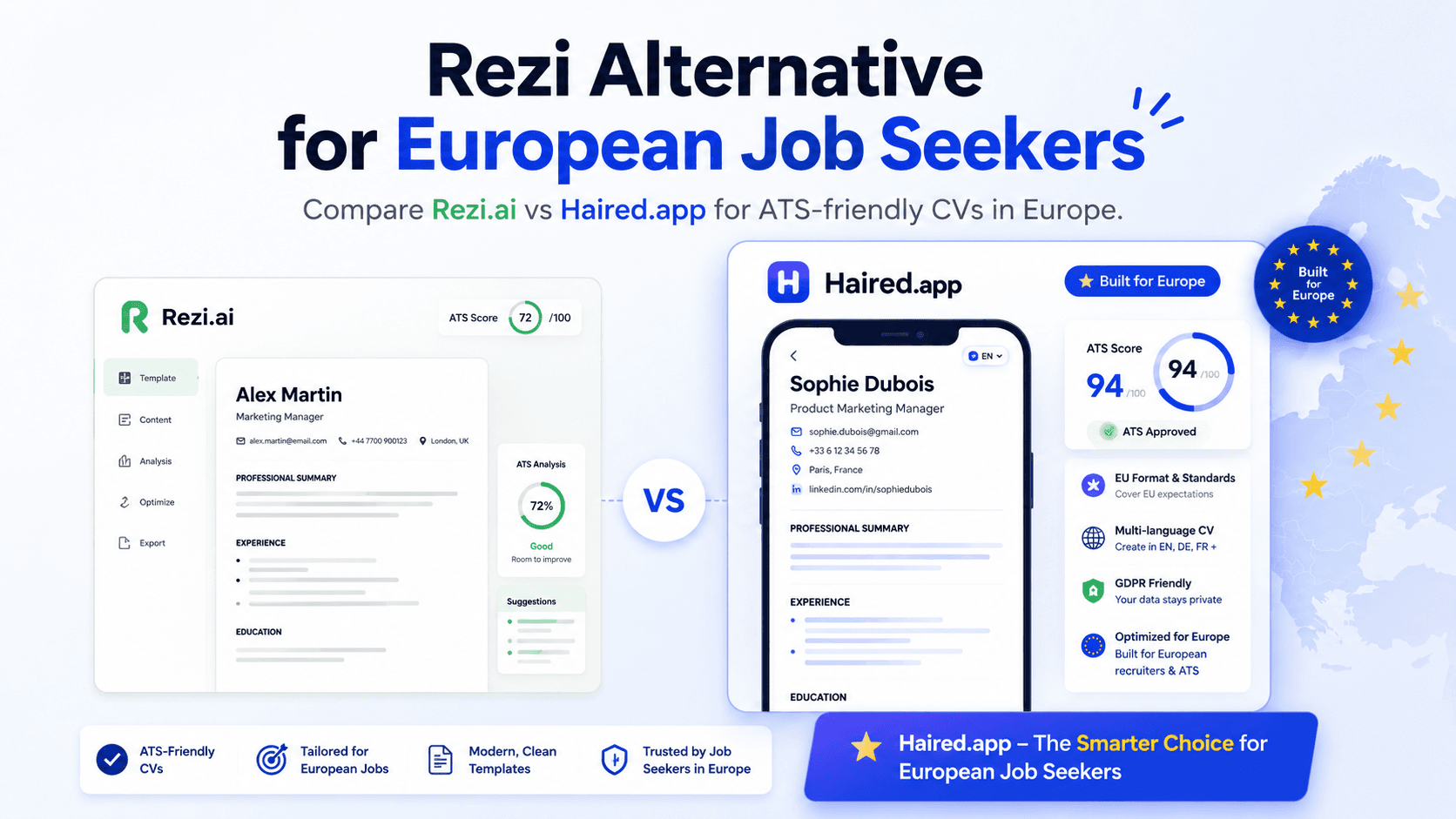
A question that comes up constantly in job search communities across Europe:
"I paid for Rezi a few years ago and forgot I even had it. Do you think it will get me past the ATS? Or should I just use ChatGPT?"
The honest answer to both: not really. And the reason why tells you exactly what's broken about how most job seekers in Europe approach ATS optimization in 2026.
The ChatGPT problem: it rewrites your resume with things you never did
The appeal of ChatGPT for resume optimization is obvious. It's fast, it's free, and if you ask it to "list keywords for this job description," it does it in seconds.
The problem starts when you ask it to do more than that.
Job seekers who use ChatGPT to rewrite their bullet points consistently report the same issue: the AI invents experience you don't have. It adjusts numbers upward, adds skills you never used, and writes responsibilities that sound plausible but weren't yours.
This creates two real risks:
- You fail a background check or technical interview because your CV claims skills or achievements you can't back up
- Your resume stops sounding like you — recruiters who speak to you after reading it notice the disconnect immediately
The job seekers who get results with ChatGPT aren't the ones who let it rewrite everything. They're the ones who use it narrowly: extracting keywords from a job description, then manually deciding which ones legitimately apply to their background.
That's a valid approach — but it's slow, requires significant judgment, and ChatGPT frequently suggests keywords that are irrelevant to your actual experience.
The Rezi problem: it only fixes your formatting
Rezi built its reputation on one thing: ATS-compliant formatting. And it does that reasonably well. Single-column layout, standard section headers, clean PDF output — the basics that prevent your CV from being mangled by parsing software.
The issue is that formatting is not why most European job seekers get rejected.
If your CV gets past the ATS but your bullet points are weak — no quantified achievements, generic descriptions, missing the keywords that actually matter for this specific role — a human recruiter still passes. Rezi doesn't help with any of that.
Beyond the formatting limitation, Rezi has become significantly more expensive over the past two years. What was a useful free or cheap tool now requires a meaningful subscription to access the features that actually matter.
For European job seekers specifically, there's another problem: Rezi is built for the US market. It assumes one-page resumes (the European standard is two pages for experienced candidates), it doesn't account for European CV conventions around photos and personal details, and its keyword suggestions are heavily skewed toward US company terminology.
What Rezi power users actually say about it
This is worth reading carefully, because it comes from someone who gave Rezi a 15 out of 10 — a genuine fan who paid for a lifetime license and used it for months:
"The AI sometimes makes things up. It doesn't know your background, so it will invent details just to write something that sounds polished. I usually write my bullet points elsewhere, using ChatGPT to ask me questions so I can answer them honestly, and then I paste them into Rezi."
That's the real Rezi workflow for the users who get the most out of it: ChatGPT for bullet content, Rezi for formatting. Two tools, two tabs, manual coordination between them.
The same review also pointed out the biggest missing feature:
"The only feature I wish it had is a browser extension that can pull job descriptions straight from the page. That would round out the platform and make it feel even more complete."
In other words: even Rezi's most loyal users want a workflow where they can paste a job description and immediately get a tailored CV — which is exactly what HAIRED's Job Match does. You paste the job description, upload your CV, and the AI rewrites your content for that specific role — using your real experience, not invented details.
This is the gap that defines why European job seekers are looking for a Rezi alternative. It's not that Rezi is bad at what it does. It's that what it does — format compliance — is only half the problem.
What European job seekers actually need from a CV tool in 2026
Before comparing tools, it's worth being clear about what the problem actually is.
1. ATS does matter — but not the way most people think
There's a persistent myth that ATS systems scan for keywords and auto-reject anything that doesn't match. The reality is more nuanced: ATS software primarily screens for clear disqualifiers (wrong location, insufficient experience, missing required certifications) and organizes CVs for human review.
Keywords matter more in technical roles where specific tool names are hard requirements. For most roles, what moves your CV from the ATS pile to a recruiter's screen is a combination of format clarity and relevant, specific experience.
This means the tools that obsess purely over "passing ATS" are solving a partial problem. The goal is to get past automated filtering AND make a recruiter want to call you.
2. European CVs have different conventions
- Two pages is standard for anyone with more than 3-4 years of experience
- Photos are accepted (and sometimes expected) in Spain, Germany, France, and most of Southern and Central Europe
- Personal details like nationality and birth date appear more commonly on European CVs than US ones
- Section structure differs — "Competencias" or "Compétences" rather than "Skills"
A tool that assumes US conventions will give you wrong advice for a European job search.
3. Job-specific tailoring is the real conversion driver
The job seekers who consistently report improved response rates in 2026 are doing one thing differently: they're not sending the same CV to every job. They're adjusting keywords, reordering bullets, and slightly rewriting their summary for each application.
This takes 30-45 minutes per application if done manually. The question is whether a tool can make it significantly faster — without inventing things you didn't do.
HAIRED vs Rezi: what's actually different for European job seekers
| Feature | Rezi | HAIRED |
|---|---|---|
| ATS format check | ✅ Strong | ✅ Strong |
| Content analysis (bullet quality) | ❌ | ✅ |
| Job-specific CV tailoring | ❌ | ✅ Job Match |
| European CV conventions | ❌ US-focused | ✅ |
| Spanish / multilingual support | ❌ | ✅ |
| Free ATS score | ⚠️ Limited | ✅ Full analysis free |
| Price | ~$29/month | Free + from €9/month |
| Rewrites based on YOUR real experience | ❌ | ✅ |
How HAIRED solves the ChatGPT problem
The reason ChatGPT adds things to your resume that aren't true is structural: it's a general-purpose language model with no knowledge of what you've actually done. It fills gaps with plausible-sounding content.
HAIRED works differently. When you use Job Match — HAIRED's feature for tailoring your CV to a specific job — it works with your existing CV as the ground truth. It identifies the gap between what you've written and what the job description requires, then suggests how to reframe and reorder your real experience to close that gap.
It doesn't invent. It reorganizes and reframes.
The difference in practice:
ChatGPT approach:
- Paste job description
- Ask for bullet points
- Get generic bullets that may not reflect reality
- Manual review to remove false claims
- Final CV sounds like every other AI-generated CV
HAIRED Job Match approach:
- Paste job description + your current CV
- AI identifies keyword gaps and weak sections
- Rewrites bullets using your actual experience as source material
- Suggests where to add quantified achievements you already have but haven't mentioned
- Final CV sounds like you, but optimized for this specific role
The result is a CV that passes ATS and reads naturally to a human recruiter — because it's still your experience, just better presented.
What the results look like
Candidates who switch from sending a single generic CV to using HAIRED's CV Optimizer + Job Match workflow consistently see two improvements:
First: Their ATS score goes from the 45-65 range (where most generic CVs land) to 80+. This removes the formatting and keyword gaps that cause silent rejections.
Second: Their response rate from human recruiters improves because the content is specific and quantified rather than generic. A recruiter reading "Managed a team" reacts differently to "Led a 6-person product team that reduced time-to-market by 30% over two quarters."
HAIRED's CV Analyzer flags exactly which bullet points are too vague and suggests how to make them specific — using the experience you described, not invented claims.
The European pricing advantage
Rezi's current pricing sits at around $29/month for meaningful features. For job seekers in Spain, Portugal, Eastern Europe, or Latin America, that's a significant cost relative to local salaries.
HAIRED has localized pricing for European and Latin American markets, making the Pro plan significantly more accessible. The free CV analysis also has no usage restrictions for the first scan — you get the full score, keyword gaps, and improvement recommendations before deciding whether to upgrade.
Which tool should you actually use?
If you're still using Rezi: the formatting check is fine, but you're leaving the harder problem unsolved. Your CV probably already has clean formatting. What it likely needs is stronger bullet points and job-specific keyword alignment.
If you've been using ChatGPT: narrow how you use it. Let it extract keywords and suggest structure, but never let it write your experience sections. The lies problem is real and the risk isn't worth it.
If you want one tool that handles both: HAIRED's CV Optimizer gives you the ATS score and content analysis for free. The Job Match feature (Pro) handles the per-application tailoring that actually moves the needle on response rates — without touching the accuracy of your experience.
The job market in Europe in 2026 is competitive enough that getting ghosted after submitting is the norm, not the exception. The candidates who get callbacks are the ones whose CVs are both machine-readable and genuinely compelling to a human. That's a content problem as much as a formatting problem — and it's where Rezi stops and HAIRED starts.
