
How to Answer "What Are Your Salary Expectations?"
The best answer to "What are your salary expectations?" is a researched range whose bottom is the number you actually want, tied to the role and the market, not to what you earn today. Something like: "Based on the scope of this role and market data, I'm targeting $95,000 to $110,000, depending on the full package." It sounds prepared, anchors the negotiation high, and never reveals your current pay. Below are the scripts for every stage and every awkward follow-up.
What Is the Best Answer to "What Are Your Salary Expectations?"
Three moves, in this order:
- Anchor on the role, not on you. "Based on the scope of this role…" frames the number as what the job is worth, not what you need.
- Give a range, with your real target at the bottom. Companies negotiate toward the low end of whatever range you give. If you want $95,000, say $95,000 to $110,000, not $85,000 to $95,000.
- Leave room on the package. "…depending on the full package" lets you trade salary for bonus, equity, remote days or a sign-on bonus later.
"Based on the scope of this role and what I'm seeing for similar positions in [city], I'm targeting $95,000 to $110,000. I'm flexible depending on the full package."
Keep it that short. The more you explain, the more it sounds like you're unsure of the number.
How Do You Figure Out the Right Number?
You can't anchor high if you don't know where "high" is. Spend 15 minutes on this before any recruiter call:
- The job posting itself. In California, Colorado, New York and Washington, employers are required to include a pay range in the listing. If it's there, that's your best data point.
- Glassdoor and LinkedIn Salary for the role at that company and in that city.
- Levels.fyi if it's a tech, finance or consulting role; it shows base, bonus and equity separately.
- Similar postings from competitors that do publish ranges.
Take the top half of what you find. If the market for the role is $85,000 to $115,000 and you're a strong fit, your range starts around $100,000.
Know Your Number Before the Call
HAIRED's salary check reads your CV and estimates what your profile is worth for your role and city, so you walk into the call with a number you can defend.
Should You Say a Number First?
Not in the first call if you can avoid it. Early on, the recruiter often asks to screen out people outside their budget, and whoever names a number first sets the anchor. Try:
"I'd love to understand the range you have budgeted for this role, so we can make sure we're aligned."
If they insist, give your researched range. Don't refuse twice; it reads as evasive, and a strong range works fine.
What Do You Put for "Desired Salary" on an Application Form?
- If the field accepts text: "Negotiable based on the full compensation package" or a range ("$95,000 to $110,000").
- If it only accepts a number: enter a figure near the top of the market range, not your minimum. Whatever you type becomes the anchor for every later conversation.
- Never enter 0 or 1 to skip the field. Some applicant tracking systems filter on it, and a human reading "$1" assumes you didn't take the form seriously.
Does your CV pass the ATS filter?
Upload it and in 30 seconds you get your score, the missing keywords and the errors getting you rejected. Free, no account, no card.
What If They Ask How Much You Make Now?
You usually don't have to say it. A growing list of US states and cities, including California, New York, Massachusetts and Illinois, ban employers from asking about your salary history. Even where it's allowed, your current pay is their anchor, not yours. Redirect:
"I'd rather focus on what this role is worth and the value I'd bring. Based on my research, I'm targeting $95,000 to $110,000."
If you're currently underpaid, this matters even more: anchoring on your current salary can cost you the raise that changing jobs is supposed to give you.
What If Their Range Is Lower Than Yours?
Don't drop your number on the spot. Find out what's flexible:
"Thanks for sharing that. Given the scope we discussed, I was expecting something closer to $105,000. Is there flexibility on base, or room on the bonus or a sign-on?"
Then stop talking. Silence after a number is one of the most effective negotiation tools there is.
Scripts for Every Situation
| Situation | What to say |
|---|---|
| First recruiter screen | "I'd love to hear the range budgeted for the role first, so we're aligned." |
| They push for a number | "Based on the scope and market data, I'm targeting $X to $Y, depending on the package." |
| Final round / offer stage | "I'm excited about the role. To accept, I'd need the base closer to $Y. Can we get there?" |
| Career change | "I'm targeting the market rate for this role, $X to $Y, given the [skill] experience I bring from [field]." |
| First job / entry level | "From what I've seen for entry-level [role] positions in [city], $X to $Y seems standard. Is that in line with your range?" |
What Are the Most Common Mistakes?
- Giving a range where your target is the top. You'll get the bottom.
- Saying your current salary when you didn't have to.
- Apologising for the number ("I know it's a lot, but…"). State it and stop.
- Negotiating only base salary and ignoring bonus, equity, remote days and start date.
- Not researching, then guessing low to be "safe".
How Does Your Resume Affect the Offer?
The offer starts before the interview. Recruiters set the range they think you're worth from your resume, and a resume that lists tasks ("Responsible for financial models") signals a lower level than one that shows results ("Built the models behind 4 acquisitions worth $1.2B"). According to HAIRED's analysis of 10,000+ resumes, 73% had at least one critical ATS error, and candidates matching 70%+ of a job description's keywords got callbacks at 5.8x the rate of those below 40%.
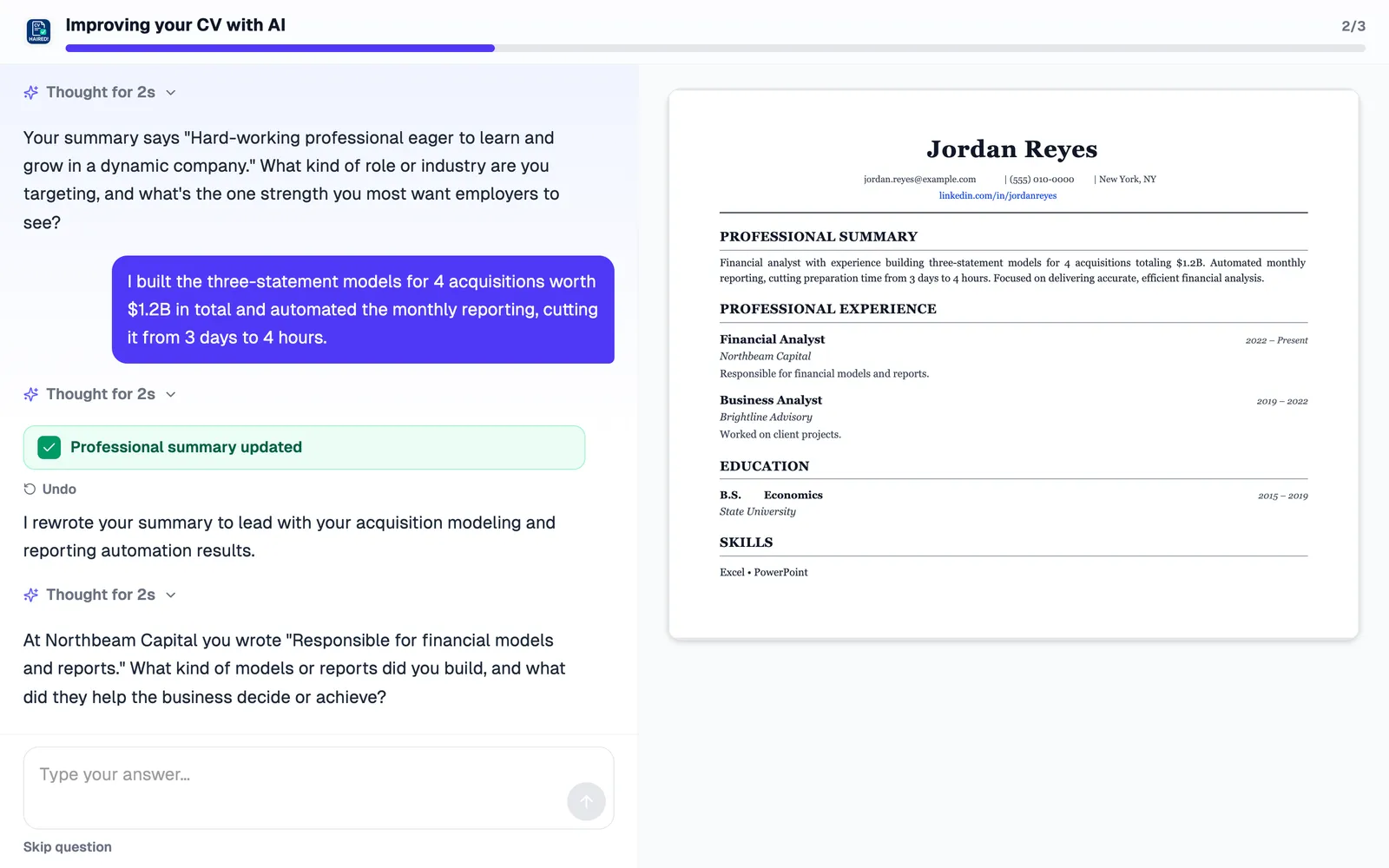
HAIRED asks about each role and rewrites your resume with your real numbers, so it reads at the level you're negotiating for.
Make Your Resume Read at the Level You're Asking For
HAIRED rewrites your experience around results and numbers and checks it passes ATS filters. Free to start.
The Bottom Line
Research the market, give a range with the number you actually want at the bottom, tie it to the role instead of your current pay, and leave room on the package. Say it once, clearly, and stop talking. That single answer is often worth thousands of dollars a year, for every year you stay in the job.
Related: What to "lie" about in a job interview (and what you never should).
