
What to 'Lie' About in a Job Interview (And What You Never Should)
🎥 This article started as a TikTok. Watch the original post on TikTok →
You should never invent facts in a job interview, but there are four things everyone frames strategically: your salary, why you're leaving (and your boss), your coworkers, and how big your results were. Dates, titles, degrees and numbers can be checked, so those stay exactly true. Everything else is about how you say it. Below is what to say for each one, word for word.
Is It Okay to Lie in a Job Interview?
Not about anything that can be verified. Employment dates, job titles, degrees, certifications and the numbers on your resume all come up in background checks and reference calls, and a discovered lie usually costs you the offer, or the job months later.
What's fair game is framing: choosing which true things to say, in what order, and with what spin. That's not lying, it's what every good candidate does. The rest of this article is about those four areas.
How Do You Answer "What Are Your Salary Expectations?"
This is the one where most people lose money. The goal is to anchor high with a range, not reveal what you earn today.
- Research the market rate for the role and city on Glassdoor, Levels.fyi or LinkedIn Salary.
- Give a range whose bottom is what you actually want, not your minimum.
- Tie it to the role, not your current pay.
"Based on the scope of this role and what I'm seeing in the market, I'm looking at $95,000 to $110,000. I'm flexible depending on the full package."
For the full playbook, including what to put on application forms and what to do if their range is lower, see how to answer "What are your salary expectations?".
Don't say your current salary. If they ask directly, redirect: "I'd rather focus on what this role is worth. What range do you have budgeted?" In a growing list of US states and cities, including California, New York, Massachusetts and Illinois, employers aren't allowed to ask about your salary history at all.
Does your CV pass the ATS filter?
Upload it and in 30 seconds you get your score, the missing keywords and the errors getting you rejected. Free, no account, no card.
How Do You Answer "Why Are You Leaving Your Current Job?"
Talk about what you're moving toward, never what you're running from. Even if the real reason is a terrible manager or a toxic team, the answer is about growth:
"I've learned a lot in my current role, and I'm looking for a team where I can own [specific thing this job offers]."
Keep it to two sentences. The longer you explain why you're leaving, the more it sounds like a problem.
What Should You Say About Your Boss in an Interview?
Nothing negative, ever, even if they deserve it. Interviewers hear criticism of a previous boss as a preview of how you'll talk about them. Turn the problem into what it taught you:
"My manager was very hands-off, which forced me to become self-directed. I'm looking for a team with more regular feedback."
Same truth, completely different impression.
How Do You Talk About Coworkers You Didn't Get Along With?
You "got along great with everyone" is the expected answer, and it's fine to give it. If they ask for a conflict example ("Tell me about a conflict with a coworker"), pick a disagreement about work, not personality, and end with how it was resolved:
"A colleague and I disagreed on how to prioritise a launch. We put both options in front of the team with data, went with theirs, and I learned to bring numbers earlier."
How Do You Make Your Results Sound Bigger Without Lying?
This is where the "lie" is really just quantifying. Most people undersell what they did because they describe tasks instead of results.
| Undersold | Same facts, framed |
|---|---|
| "Helped with customer onboarding" | "Cut onboarding time from 10 to 6 days for 200+ new customers" |
| "Managed social media" | "Grew Instagram from 2K to 11K followers in 8 months" |
| "Worked on the sales team" | "Closed $340K in new business, 120% of quota" |
The numbers have to be real; the framing is the skill. And it matters before the interview too: according to HAIRED's analysis of 10,000+ resumes, 73% had at least one critical ATS error, and candidates matching 70%+ of a job description's keywords got callbacks at 5.8x the rate of those below 40%. If your resume describes tasks instead of results, you often don't get the interview in the first place.
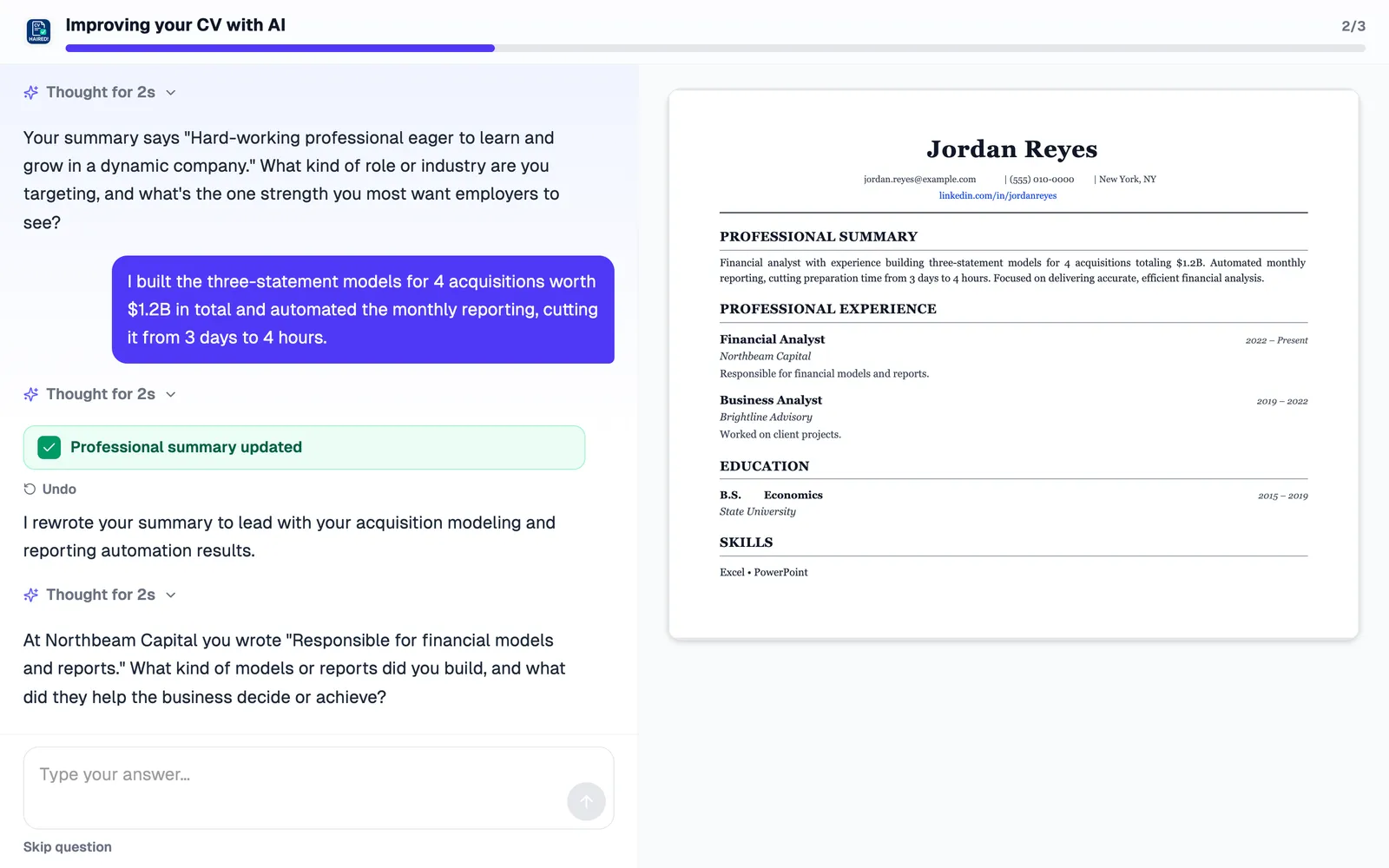
HAIRED asks about each role and rewrites the line on your CV with your real numbers, live.
That's exactly what HAIRED's CV optimizer does: you paste your experience and the AI rewrites each line around results and numbers, then checks it against the job you're applying for.
Make Your Results Sound as Big as They Were
Paste your CV and HAIRED rewrites each line around results and numbers, then checks it passes ATS filters. Free to start.
What Should You Never Lie About in an Interview?
- Dates and job titles. Background checks verify both.
- Degrees and certifications. One email to the university.
- The numbers themselves. Framing "grew revenue 30%" is fine; inventing it isn't.
- Skills you'll be tested on. If the job needs SQL, someone will ask you to write SQL.
The Bottom Line
Don't lie in an interview, frame. Anchor your salary with a researched range, explain your move as growth, never criticise a boss or coworker, and turn every task on your resume into a measurable result. The facts stay true; the impression changes completely.
