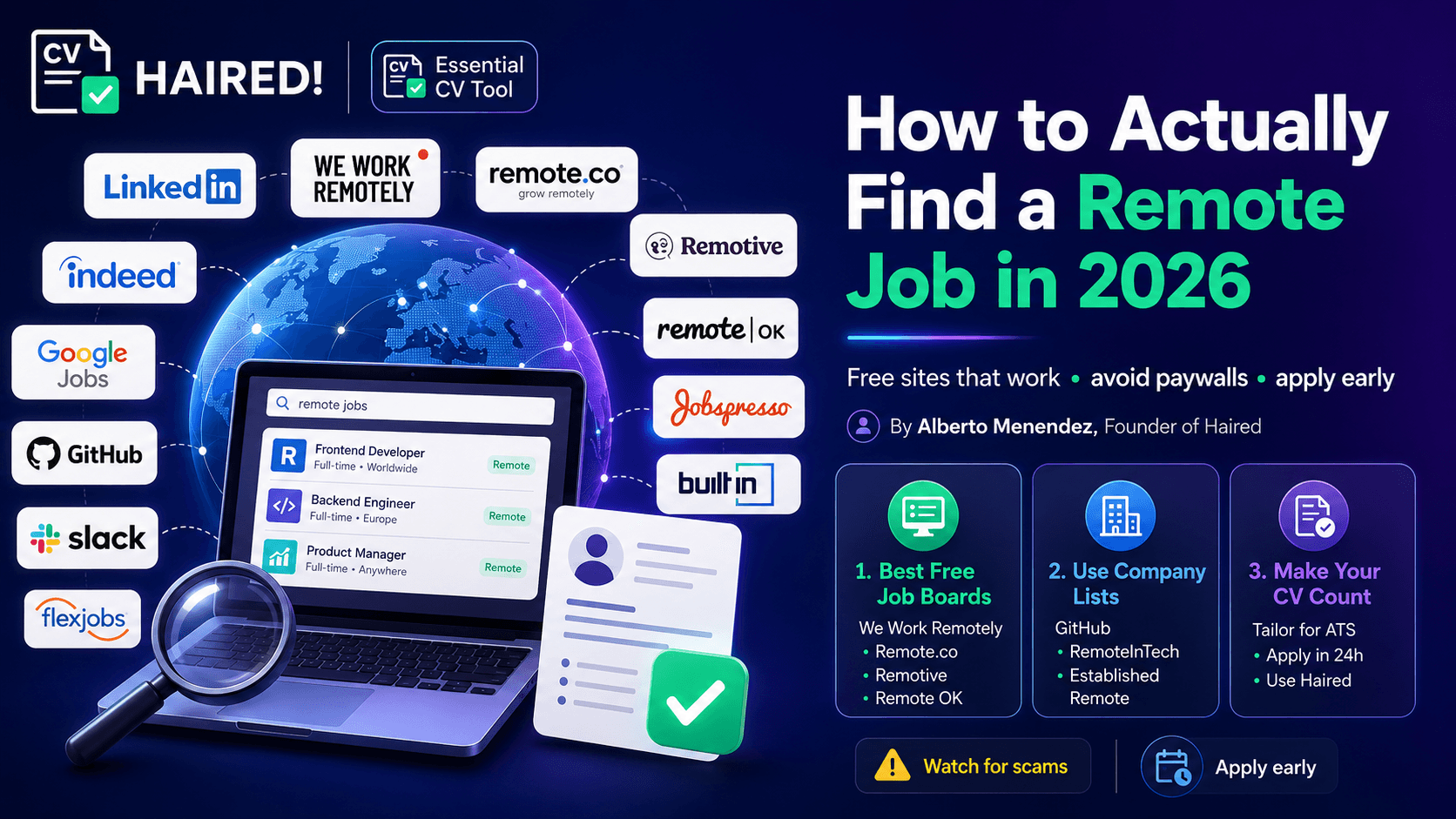
How to Actually Find a Remote Job in 2026 (Without Paying for a Job Board)
Here's something that strikes most people as absurd: some of the most popular advice for finding a remote job involves paying a monthly subscription to access job listings.
You're looking for work — presumably because you need income — and the suggested solution is to spend money first.
The frustration is real. Reddit threads on remote work have thousands of upvotes from people who've exhausted LinkedIn and Indeed and still can't find anything. The comments don't hold back:
"I think especially for being entry level, it's ridiculously hard. Either you must pay a subscription to find a job, which defeats the whole purpose of looking for a job because 9 times out of 10 you're job hunting because you don't have money."
The good news: you don't need to pay. The paid platforms aren't meaningfully better than free alternatives — they're just better marketed.
Here's the complete free strategy.
Why LinkedIn and Indeed Aren't Enough
Both platforms are valuable, and you should use them. But treating them as your only search channels means you're missing a significant chunk of the remote job market.
The problems:
Remote listings are buried. Both platforms list millions of jobs — the majority of which are not remote. Without careful filtering, remote roles get lost in local results. Many job seekers don't realize you need to actively filter for "Remote" as a location and not just a keyword.
Remote-first companies often don't post there. Companies that have been remote-first since founding tend to recruit through communities, referrals, and niche boards where their target hires are already spending time. If you only check LinkedIn, you're seeing the companies that do traditional recruiting — not necessarily the ones with the best remote culture.
Competition is disproportionately high. A remote role on LinkedIn with "Easy Apply" enabled can receive 1,000+ applications within 48 hours. Your application enters a queue where a recruiter, overwhelmed by volume, may never reach your name.
This doesn't mean stop using them — it means stop relying on them exclusively.
The Free Sites That Actually Work
These platforms specialize in remote roles only. Fewer applicants per listing, more vetted postings, and a cleaner signal-to-noise ratio than the big generalist platforms.
We Work Remotely — weworkremotely.com
One of the oldest and most respected remote job boards. Strong for roles in tech, marketing, design, and customer support. Updated daily, free to browse, no account required to search.
Remote.co — remote.co/remote-jobs
Well-curated listings with a mix of roles across industries. The site also has guides and resources for remote workers, which makes it useful beyond just job listings.
Remotive.io — remotive.io
A remote job board with a strong tech and startup focus. Posts in real-time and has a free Slack community where companies sometimes share roles before they're officially listed.
Remote OK — remoteok.com
Real-time listings pulled from multiple sources, skewed toward tech but with a growing range of other categories. Shows the number of applicants on each listing, which is useful for gauging competition.
Jobspresso — jobspresso.co
Smaller and more curated than the others, which means less volume but higher quality filtering. Good for professional and creative roles.
BuiltIn Remote — builtin.com/jobs/remote
BuiltIn focuses on tech companies and startups. The remote filter surfaces roles that tend to be at companies with genuine remote cultures, not just companies allowing home-office as a temporary policy.
RemoteHub — remotehub.com/jobs
A newer platform with both job listings and a community component. Worth monitoring for newer listings before they appear on aggregators.
The Meta-Directory Trick
Instead of checking ten job boards manually every day, use a meta-directory to search across all of them at once.
JobBoardSearch.com — a directory of job boards organized by category, industry, and location. Useful for finding niche boards you didn't know existed.
Google's hidden remote job filter — try searching "remote" [job title] jobs directly in Google. Google has a built-in job search that aggregates listings from multiple sources and shows them in a structured panel. Many people don't use this at all.
The Company Lists Nobody Talks About
Some of the most reliable remote opportunities aren't on job boards at all — they're at companies that have publicly committed to being remote-first or remote-friendly, many of which are always hiring in some capacity.
remoteintech.company (also on GitHub) — a community-maintained list of companies in the tech sector that hire remotely. Most are legitimate companies with ongoing hiring needs.
Established Remote on GitHub — companies known to hire globally. If you find a company on this list that interests you, go directly to their careers page rather than waiting for a job board listing. Some remote-first companies fill roles before they're ever formally posted.
The strategy: identify 10–15 companies from these lists that you'd genuinely want to work for, bookmark their careers pages, and check them weekly. This direct approach puts you in front of roles before they hit the big platforms and get buried under hundreds of applicants.
Found a Role You Want? Make Your Application Count
The difference between a callback and silence is often a single thing — whether your resume mirrors the language in the job description. Our CV Optimizer compares your resume against any job posting in seconds.
Communities: Where the Real Tips Come From
The most underused resource for remote job searching is community — places where people share leads, warn about scams, and occasionally post roles that never make it to job boards.
Reddit:
- r/RemoteWork — general remote work discussion and occasional job leads
- r/WorkOnline — focused on online and remote work, good for entry-level
- r/jobboardsearch — a community specifically about job board resources
Slack communities — many remote-first industries have Slack groups where members share job leads, referrals, and company news before it becomes public. Search for "[your industry] remote Slack" to find the relevant ones.
Facebook groups — there are several active groups focused on remote work, particularly for entry-level and customer service roles. Quality varies significantly — filter for groups that are actively moderated and ban spammy "make money from home" posts.
About FlexJobs and Other Paid Boards
FlexJobs is often the first recommendation for remote work and it deserves honest context.
What it does well: Every listing is manually vetted, which means you're not wading through scams or outdated postings. The filtering tools are good. If you're job searching seriously for a multi-month sprint, the subscription cost (~$9.95–$59.95 depending on the plan) may be worth it.
What the criticism gets right: Paying to find a job does feel backwards when you don't have income. And the listings that appear on FlexJobs often appear on free platforms too — with a day or two of lag. If you're already monitoring We Work Remotely, Remote.co, and company career pages directly, you're likely not missing much.
The verdict: Start with the free resources. If after 4–6 weeks of consistent searching you're not finding enough relevant listings, a one-month FlexJobs subscription is a reasonable experiment.
A Note on Scams (Read This Before Applying Anywhere)
The remote job market is infested with scams. The more desperate the job seeker, the more targeted they are.
Signs of a legitimate opportunity:
- The company has a real website with an "About" page, physical address, and traceable history
- The salary range is in line with market rates for the role
- The application process starts with a formal job posting, not a direct WhatsApp or Telegram message
- They ask for your resume, not your bank account details or national ID at the application stage
Signs of a scam:
- Unusually high pay for entry-level or vague work ("$500/day from home, no experience required")
- They ask you to pay for equipment, training, software, or a "starter kit"
- Communication happens entirely through personal messaging apps with no company email involved
- The job description is vague and shifts when you ask specific questions
If you're unsure about a company, search "[company name] scam" or "[company name] reviews" on Reddit. Other people have almost certainly encountered them before.
The One Part Most People Skip
Here's the frustrating part of all this: finding the job posting is only half the problem.
Many people — especially entry-level remote job seekers — can identify dozens of relevant roles. The issue is that their applications don't generate callbacks. The job boards are working. The resume isn't.
In a remote job search, your resume is working harder than it would be for a local role. There's no face-to-face interview to look forward to. There's no local reputation or network advantage. Your application goes into a queue with applications from around the world, and the only thing a recruiter has to evaluate you with initially is what's on the page.
Two things matter most:
1. Tailoring to the specific job description. Remote job postings are often screened by ATS software before a human ever sees them. If your resume doesn't contain the specific keywords and phrases from the job description, it may be filtered out automatically. A generic resume sent to fifty roles will almost always underperform compared to ten carefully tailored applications.
2. Applying early. Recruiters review applications roughly in the order they arrive. Many close postings or stop reviewing once they have a viable shortlist — sometimes within 3–5 days of posting. Set up job alerts on every platform you use so you're notified the moment new roles appear.
Apply Smarter, Not More
Tailored applications get 6x more callbacks than generic ones. Use our Job Match tool to instantly rewrite your CV for any specific role — so every application you send is genuinely competitive.
Your Action Plan
Here's a practical week-by-week approach for someone starting from scratch:
Week 1 — Set up your search infrastructure
- Create or update profiles on LinkedIn and Indeed (still worth having)
- Set up free accounts and job alerts on We Work Remotely, Remote.co, and Remotive
- Bookmark the GitHub company lists relevant to your field
- Join 2–3 relevant communities on Reddit or Slack
Week 2 — Build your target company list
- Browse the remote-first company lists and identify 10–15 companies you'd genuinely want to work for
- Bookmark their careers pages
- Check each careers page for current openings
Week 3 — Start applying, but do it right
- Apply to no more than 5 roles per day, and tailor each application specifically to the job description
- Mirror the language from the job posting in your resume and cover note
- Apply to new postings within 24 hours of them going live
Week 4+ — Refine based on feedback
- Track which applications are getting responses and which aren't
- If you're applying but not getting callbacks, the issue is likely the resume — not the platforms you're using
- Revisit your resume and run it against the job descriptions you're targeting
Quick Reference: The Free Resources That Matter
| Category | Resource |
|---|---|
| General job boards | We Work Remotely, Remote.co, Remotive.io |
| Tech-focused | Remote OK, BuiltIn Remote |
| Company directories | remoteintech.company, GitHub Established Remote |
| Meta-search | JobBoardSearch.com, Google job search |
| Communities | r/RemoteWork, r/WorkOnline, industry Slack groups |
| Resume quality | HAIRED CV Optimizer, Job Match |
For a complete list of 70+ remote job boards organized by industry and role type, see our full remote job board directory →
The platforms exist. The jobs exist. The bottleneck for most people isn't finding the listings — it's showing up with a resume that earns a callback once they do. Fix the resume, expand beyond LinkedIn and Indeed, and apply early. That combination does more than any job board subscription.
Sources:
- Reddit r/remotework and r/WorkOnline community discussions (2025–2026)
- We Work Remotely, Remote.co, Remotive.io — platform documentation
- GitHub: remoteintech/remote-jobs, Uncodedtech/established-remote
- JobBoardSearch.com resource directory
