Best Places to Find a Remote Job in the USA in 2026
A quick search for "remote" on LinkedIn turns up thousands of listings. It also turns up almost zero replies for most people. That gap — between how many jobs are visible and how many actually respond — is the real story of remote hiring in the U.S. right now, and it's the exact frustration that sparked the Reddit discussion this article is built around.
Someone posted a simple question: "Best websites for remote jobs?" They'd been laid off from a remote junior graphic design role, had applied to 20+ jobs on LinkedIn in two weeks, and heard nothing. The thread got 246 upvotes and dozens of replies from people sharing what's actually worked for them — and a recurring theme that silence doesn't mean you're doing something wrong.
Here's the full list of sites people recommend, the application habits that came up again and again, and what's missing from most "best job boards" lists: what to do about your CV once you've found the role.
Why LinkedIn Alone Isn't Working
LinkedIn is useful — it's also the most saturated remote job platform that exists, simply because every job seeker defaults to it first. A remote-eligible posting on LinkedIn can collect 200 to 300+ applications within the first 48 hours. Indeed and Glassdoor aren't far behind.
This doesn't mean LinkedIn is broken. It means LinkedIn alone is not a strategy. As one commenter on the thread put it bluntly:
"20 jobs is nothing and almost two weeks is basically zero weeks. Hiring processes can take months. Jobs get so many applicants you may never even be formally rejected."
That's not an excuse to stop applying — it's context for calibrating your expectations and, more importantly, for spreading your search across more than one platform.
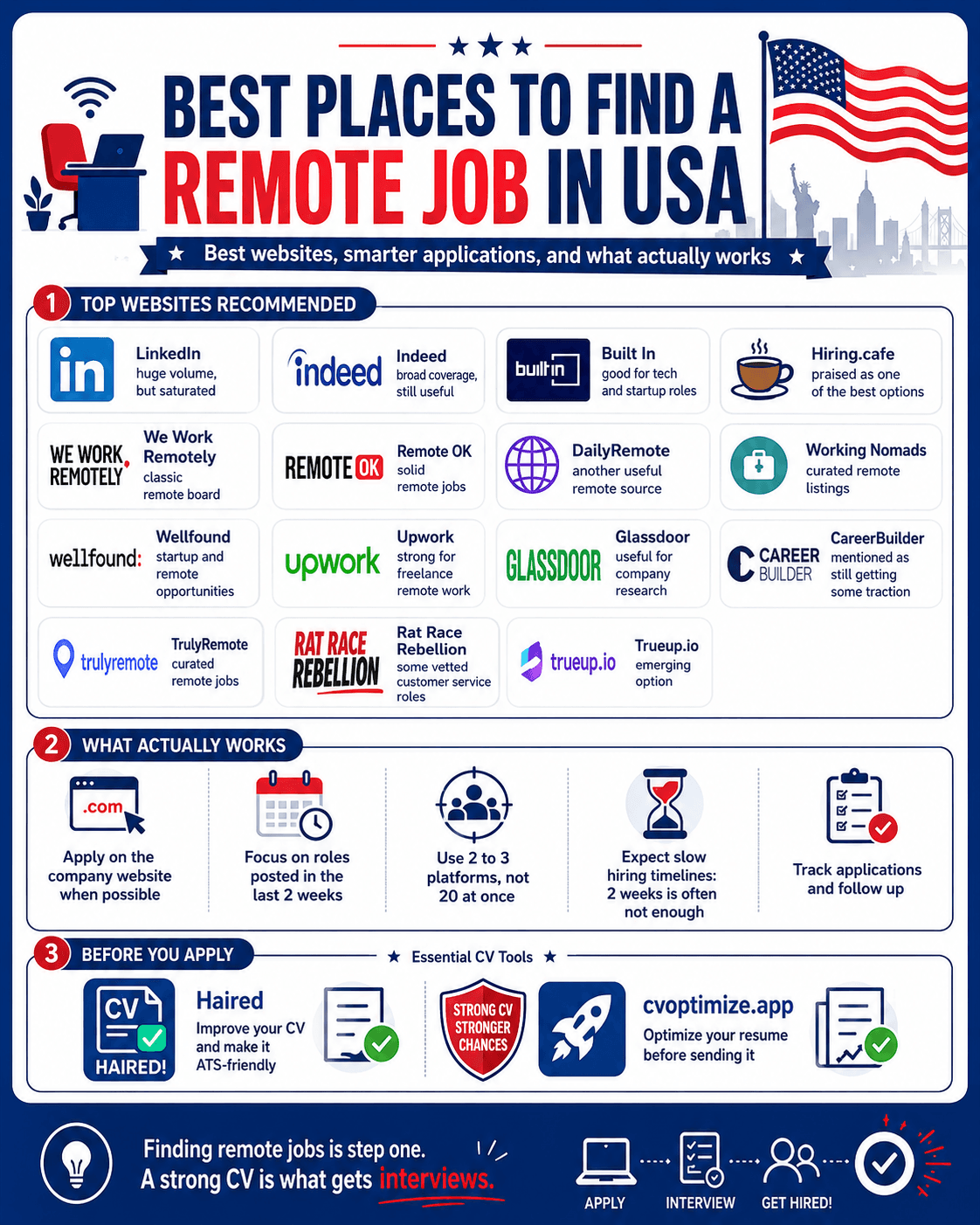
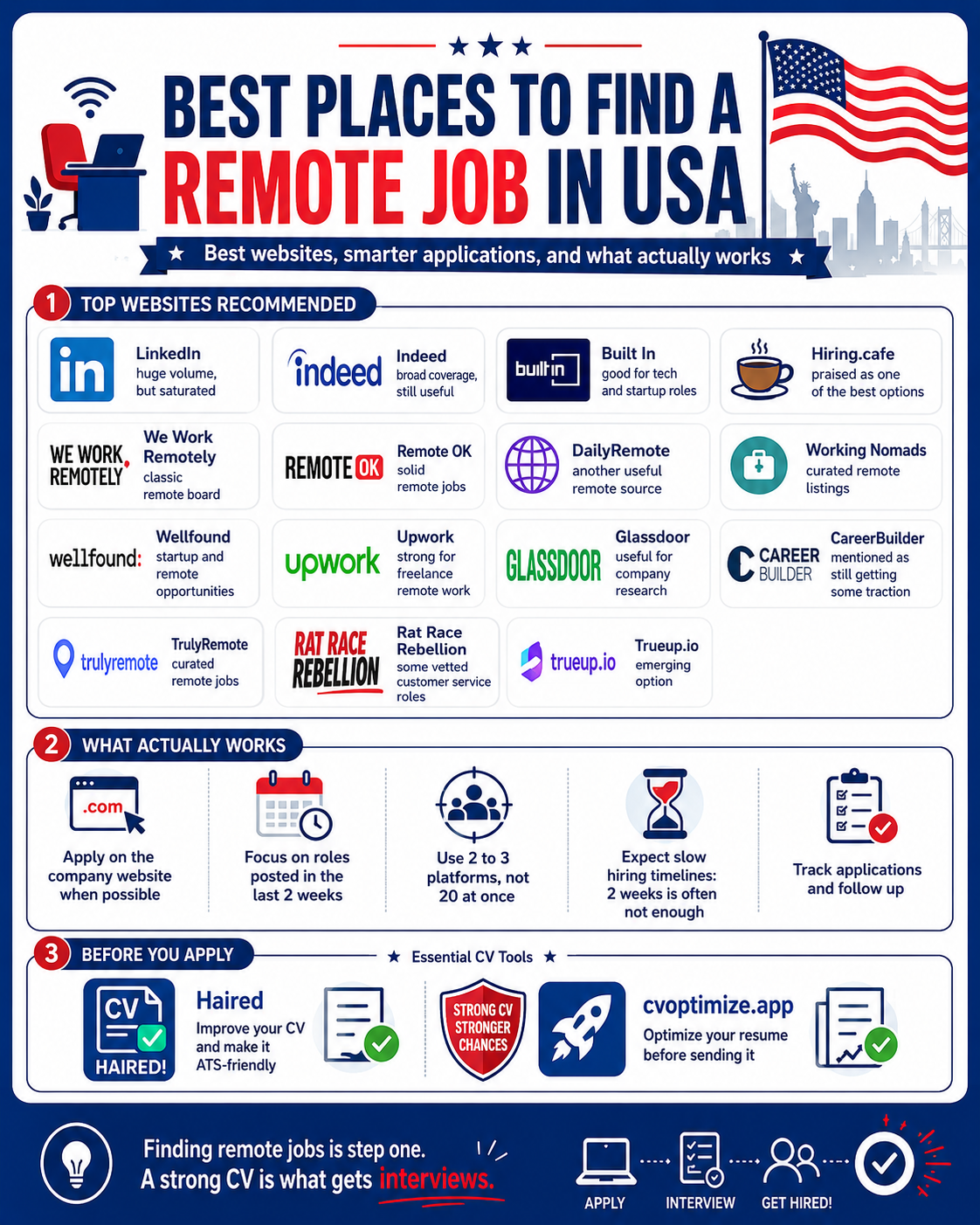
The 15 Sites People Actually Recommend
These are the platforms that came up across the thread, organized by how often they were mentioned and what they're best for.
| Platform | Best for | Why it's recommended |
|---|---|---|
| Volume and discovery | Largest listing pool, but apply on the company site, not "Easy Apply" | |
| Indeed | Broad coverage | Wide reach across industries, also heavily saturated |
| Built In | Tech and startup roles | Strong for tech hubs (NYC, Austin, SF) with a remote filter |
| Hiring.cafe | Fresh, deduplicated listings | The most upvoted recommendation in the thread — scrapes roles directly from company career pages |
| We Work Remotely | Tech, design, marketing, support | One of the oldest and highest-traffic remote-only boards |
| Remote OK | Developers and tech | High volume of remote-only tech roles, updated daily |
| DailyRemote | Fresh postings | Aggregates new remote listings daily across industries |
| Working Nomads | Curated remote roles | Hand-picked listings, good signal-to-noise ratio |
| Wellfound (formerly AngelList) | Startup roles | Strong for early-stage and growth-stage startup positions |
| Upwork | Freelance and contract work | Best if you're open to project-based remote work, not just full-time |
| Glassdoor | Company research + listings | Useful to cross-check culture and pay before applying elsewhere |
| CareerBuilder | General roles | One commenter said it's "still getting some traction" compared to bigger boards |
| TrulyRemote | Curated remote roles | Hand-picks and publishes new remote listings daily |
| Rat Race Rebellion | Customer service, phone-based roles | Job board that claims to vet listings before publishing |
| TrueUp | Tech and startup roles | Newer aggregator gaining traction among tech job seekers |
The most upvoted tip in the thread: Hiring.cafe got more upvotes than any other single recommendation, with people specifically calling out that it "scrapes the web" — meaning listings come straight from company career pages rather than being re-posted and duplicated across boards. That freshness is exactly what matters when timing your application.
Found a Role You Want? Make Sure Your CV Gets Through
Most companies hiring remotely run every application through an ATS before a human sees it. Our CV tool checks your resume against the actual job description in seconds.
More Sites Worth Bookmarking
Beyond the top recommendations, several other tools came up in the discussion that are worth knowing about depending on your situation:
- Future4DayWeek — Only lists remote roles with a 4-day work week. Fewer listings, but a useful filter if that's a priority.
- FlexJobs — A paid board ($9.95-$59.95 depending on plan length) that vets every listing to cut down on scams. Several commenters specifically recommended it alongside Monster and Working Nomads for non-tech remote roles.
- Monster — General job board, less saturated than LinkedIn for some industries.
- AIApply — Application automation tool mentioned by one commenter, worth evaluating against the "quality over quantity" advice below.
- RemoteIndian and niche regional communities — If you're searching from outside the core U.S. talent pool but targeting U.S.-based remote roles, region-specific communities can surface opportunities general boards miss.
What Actually Works, According to the Thread
Past the list of sites, the most useful part of the discussion was the pattern in what people say actually moves the needle. Here's what came up repeatedly:
1. Apply on the company website when possible
Multiple commenters made this point independently: if you find a role on LinkedIn or Indeed, search for the same posting on the company's own careers page and apply there directly.
"I never apply directly on LinkedIn, if I find a job I like I go directly to their website. I also only apply to jobs posted within the past 2 weeks max."
Applying through a platform's "Easy Apply" funnels you into a massive, less-segmented pool. Applying directly often routes you into the company's actual ATS with fewer duplicate or stale applications ahead of you.
2. Stick to recent postings
Several people converged on the same window: jobs posted within the last 1-2 weeks are worth your time. Older listings have usually already accumulated hundreds of applicants, or the role has quietly been filled while the post stays live.
3. Use 2-3 platforms, not all of them
Spreading yourself across 15 sites at once isn't a strategy, it's a way to burn out without tailoring anything. Pick one general board (LinkedIn or Indeed), one niche or aggregator site (Hiring.cafe or Built In), and one community, then go deep on those instead of wide on everything.
4. Expect slow timelines and track your applications
"Hiring processes can take months. Jobs get so many applicants you may never even be formally rejected."
Since most companies won't tell you where you stand, you have to track it yourself: company, role, date applied, source, status, and a follow-up date. It's the only way to see what's actually converting versus what's just consuming time.
5. Treat your CV as the real bottleneck, not the job board
This is the part most "best sites" lists skip entirely, and it's the one a recent comment on the thread nailed:
"Treat boards like data sources. Run the same query across two or three, export roles to a sheet, and tag each for pay visibility, company name, and posting age. After a week, sort by interviews generated, not clicks. Keep a snippet file with two intros and three measurable bullets. Less context switching = more energy to tailor the top of your resume."
Finding the job is step one. Getting noticed once you've found it is the harder, less talked-about step — and it depends almost entirely on whether your CV is built to pass an ATS and speaks the same language as the job description.
Apply Smarter, Not More
Tailored applications consistently get more callbacks than generic ones. Build or optimize your CV so every remote application you send is actually competitive.
Why Silence Doesn't Mean You're Doing Something Wrong
It's worth repeating, because it's the thing most job seekers internalize incorrectly: not hearing back is the default, not the exception, in the current remote hiring market.
A few data points from the discussion and the broader market worth keeping in mind:
- Remote roles posted on general platforms can collect hundreds of applications within days of going live.
- Many companies have stopped sending formal rejections altogether — the listing simply disappears, or stays up as a placeholder.
- Interview processes for remote roles tend to run longer, not shorter, than in-person roles, since they often involve more asynchronous stages and a larger, more geographically spread applicant pool.
- Panel interviews, take-home assessments, and multiple rounds are increasingly common — several commenters described being told "we really liked your experience, but we went with someone internally" after multiple rounds.
None of this means stop applying. It means calibrate: two weeks of silence after 20 applications is not a signal to change your entire approach. It's the market behaving the way it currently behaves.
Before You Apply: Fix the CV, Not Just the Job Board
The infographic above ends on this point for a reason. Finding the right site solves half the problem — the other half is making sure that once a recruiter or an ATS opens your application, it actually holds up.
A few things worth checking before you send another application:
- Does your CV mirror the job description's actual keywords? ATS systems rank applications by keyword match. A CV that looks polished as a PDF can still score low if it's not structured around the language the posting uses.
- Is your file format ATS-readable? Heavily designed templates with text boxes, columns, or graphics often fail to parse correctly, even when they look great to a human.
- Does it explicitly mention remote experience? Async communication tools you've used (Slack, Notion, Jira), prior remote roles, and your time zone availability are all signals that you already know how to work distributed — and remote hiring managers specifically look for them.
This is exactly what Haired is built for: an ATS-friendly CV builder and a CV-to-job-description match checker, so you're not guessing whether your application will actually get read before you send it to one more board on this list.
Build a CV That Survives the ATS
Create an ATS-ready resume, then check it against any specific remote job posting to see what's missing before you apply.
- Premium ATS-optimized templates
- AI-powered keyword optimization
- Instant ATS score checker
Frequently Asked Questions
What is the best website to find a remote job in the USA? There's no single best site, but Hiring.cafe came up as the most upvoted recommendation in the discussion because it scrapes listings directly from company career pages, so postings are fresher and less duplicated. We Work Remotely and Remote OK lead on raw volume, and Built In is strong for tech roles in specific U.S. metro areas with a remote filter.
Why am I not hearing back after applying to remote jobs? Silence is the default outcome right now, not a sign you did something wrong. Remote postings on LinkedIn and Indeed routinely collect 200-300+ applications within days, and many companies never send a rejection — the listing simply disappears once filled.
Is LinkedIn still worth using for remote jobs in the USA? Yes, but not as your only source. Use it to discover openings, then apply directly on the company's career page when possible — LinkedIn's "Easy Apply" puts you in a much larger, less-filtered pool than applying on a company site directly.
How long does it typically take to hear back? It varies, but two weeks of silence is common and doesn't mean the process is over. Many remote hiring pipelines take 4-8 weeks from posting to offer.
Should I pay for a job board like FlexJobs? It depends on how time-constrained your search is. Paid boards vet listings to cut down on scams. For most people, the free sites in this list cover the same companies without the subscription.
What's the single biggest mistake people make? Applying to a high volume of roles with the same generic CV. A tailored CV that mirrors the job description consistently outperforms a one-size-fits-all version sent to more companies.
The list of sites and application tips in this article is drawn from a Reddit discussion among U.S. job seekers actively searching for remote work, with added context and structure to make it easier to act on.
