The best remote job boards for LATAM professionals in 2026 combine at least one LATAM-specific platform (GetOnBrd, Torre, or Workana) with one high-volume global board that explicitly accepts Latin America-based candidates (We Work Remotely, Remote OK, or Working Nomads). LATAM-specific boards surface roles at employers actively looking for LATAM talent — often with realistic USD pay — while global boards add volume, but require filtering out listings restricted to "US only" or "EU only." Most job seekers who land remote roles from Latin America use two or three platforms in parallel, not one.
That's the short version. Below is the full breakdown: which platforms are actually worth your time in English and in Spanish, what job seeker communities say really works, realistic salary ranges, and the scam patterns that specifically target LATAM applicants.
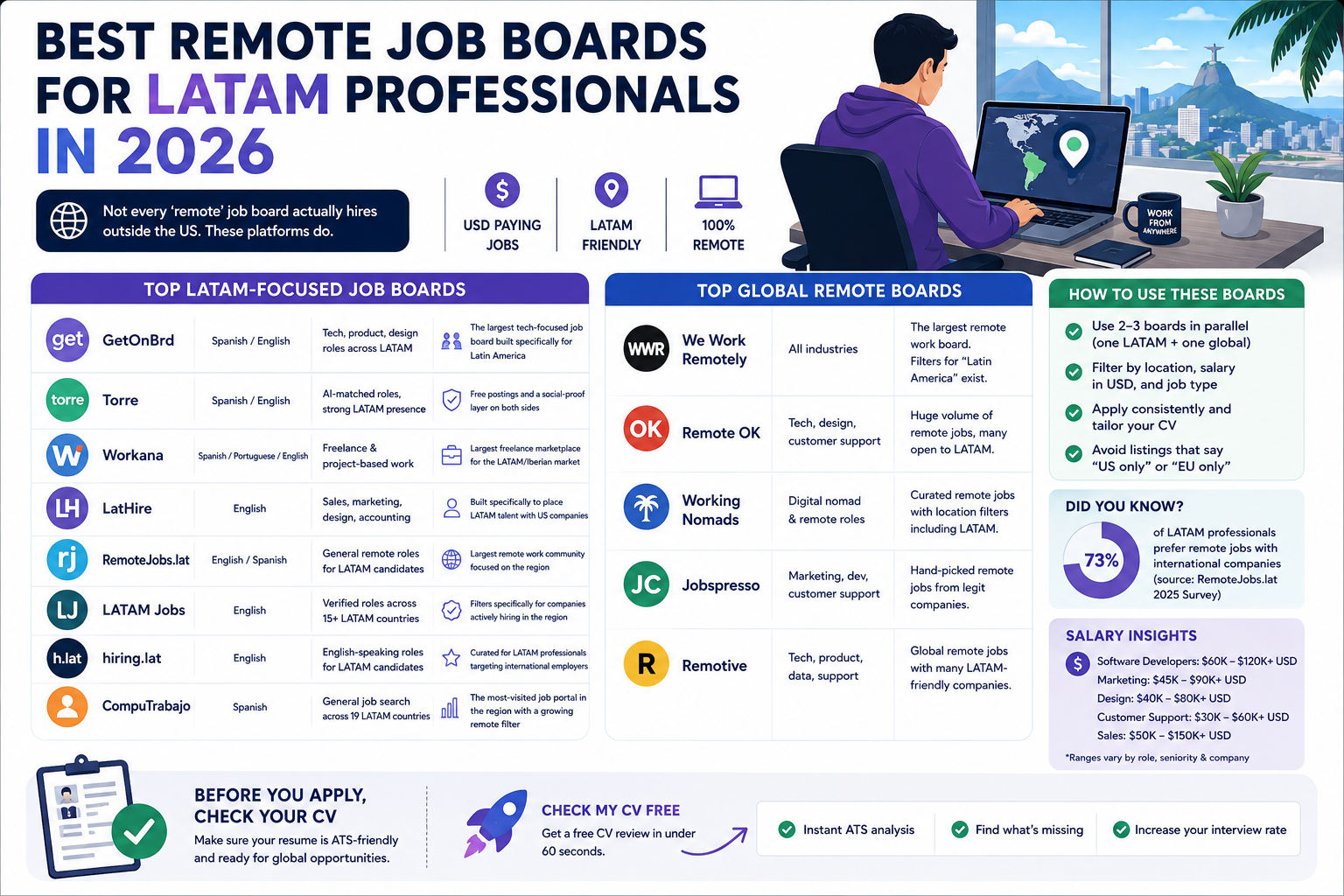
Which Job Boards Actually Hire LATAM Professionals Remotely?
Not every board that says "remote" means "remote from anywhere." A huge share of listings on LinkedIn, Indeed, and even niche remote boards restrict roles to "US-based" or "must be authorized to work in [country]" — filters that quietly exclude LATAM applicants before they even click apply. The boards below were selected specifically because they either focus on LATAM talent or clearly welcome LATAM-based applicants at the listing level.
| Platform | Language | Best For | Why It's on This List |
|---|---|---|---|
| GetOnBrd | Spanish / English | Tech, product, design roles across LATAM | The largest tech-focused job board built specifically for Latin America |
| Torre | Spanish / English | AI-matched roles, strong LATAM presence | Free postings and a social-proof/validation layer on both sides |
| Workana | Spanish / Portuguese / English | Freelance and project-based remote work | Largest freelance marketplace for the LATAM/Iberian market |
| LatHire | English | Sales, marketing, design, accounting roles | Built specifically to place LATAM talent with US companies |
| RemoteJobs.lat | English / Spanish | General remote roles for LATAM candidates | Largest self-described remote work community focused on the region |
| LATAM Jobs | English | Verified roles across 15+ LATAM countries | Filters specifically for companies actively hiring in the region |
| hiring.lat | English | English-speaking roles for LATAM candidates | Curated for LATAM professionals targeting international employers |
| CompuTrabajo | Spanish | General job search across 19 LATAM countries | The most-visited job portal in the region — has a growing remote filter |
How to use this table: Pick one general LATAM board (GetOnBrd or CompuTrabajo) and one specialized one relevant to your field (Torre for a broad professional profile, Workana if you're open to freelance/project work, LatHire if you specifically want to work for a US company). Applying to all eight at once is a fast route to burnout with diminishing returns.
Before You Apply Anywhere, Check Your CV
LATAM candidates compete in a global applicant pool where an ATS reads your resume before any human does. See exactly what's missing in under a minute.
Which Global Remote Boards Actually Accept LATAM-Based Candidates?
Global boards have the highest raw volume of listings, but you have to filter carefully — many roles marked "remote" are restricted by country for tax and legal reasons. These are the global platforms where LATAM-based applicants routinely get interviews, not just silence:
| Platform | Best For | LATAM Note |
|---|---|---|
| We Work Remotely | Tech, design, marketing, support | Largest remote-only board by traffic; many listings are open worldwide |
| Remote OK | Developers and tech professionals | Filter by "Worldwide" or "Anywhere" to see LATAM-eligible roles |
| Working Nomads | Curated remote roles | Maintains a dedicated Latin America remote jobs page |
| Remotive | Curated tech and startup roles | Manually vetted, fewer geo-restricted listings than aggregators |
| JustRemote | All roles, strong filters | Filter by region to isolate genuinely global-eligible roles |
| Braintrust | Freelance and contract tech talent | Talent-owned network with a strong LATAM developer base |
| Toptal | Elite freelance, top 3% vetting | Rigorous screening, but consistently pays USD rates well above local market |
| X-Team | Remote developer roles | Built specifically around distributed, timezone-flexible dev teams |
The filtering trick that saves the most time: On any global board, search the role plus "worldwide," "anywhere," or "global remote" instead of just "remote." Listings that say "remote (US)" or "remote (must be authorized to work in the EU)" will still show up in a generic remote search — they just won't respond to LATAM applicants.
What Do Job Seeker Communities Say Actually Works?
A quick note on sourcing: Reddit's own search does not surface many highly-upvoted, LATAM-specific "best job boards" megathreads the way it does for US-focused remote work questions — the discussion is more scattered across r/WFH, r/digitalnomad, r/forhire, r/cscareerquestions, and country-specific subreddits (r/argentina, r/mexico, r/vzla, r/chile) rather than concentrated in one thread. Pulling the recurring themes from those communities and adjacent professional forums like Blind, a few patterns show up consistently:
Nearshoring is the real driver, and people notice it. The recurring observation across these communities is that US companies are increasingly hiring in Argentina, Chile, Brazil, Colombia, and Mexico specifically because of timezone overlap — a LATAM-based hire can join the same standups and meetings as a US team, which isn't true of hires in most of Asia or Eastern Europe. That overlap is repeatedly cited as the single biggest reason LATAM hiring has grown faster than hiring in other lower-cost regions.
Country-based rejection is a common, specific frustration. A theme that comes up again and again: qualified candidates getting filtered out — sometimes after multiple interview rounds — once a recruiter clocks their location, even for roles advertised as "remote." The practical takeaway from these threads is consistent: confirm explicitly, early in the process, whether a company is actually set up to hire and pay in your country, rather than assuming "remote" means "remote from anywhere."
Applying directly on the company's own careers page outperforms platform "easy apply" buttons — the same advice that shows up in US-focused remote work threads holds for LATAM applicants too, and matters even more given how much LATAM-restricted filtering happens inside platform algorithms rather than the job description itself.
Compensation expectations vary wildly by thread, which is itself useful information. Some commenters report senior engineering roles from US companies paying well into five figures per month; others report LATAM-based roles at regional companies paying far closer to local market rates even when advertised as "remote-first." The lesson from the spread isn't a single number — it's that "remote" and "pays US rates" are two separate claims, and confirming both before investing time in an application saves real effort.
Tailored Applications Get 5.8x More Callbacks
HAIRED's analysis of 10,000+ resumes found candidates whose CV matched 70%+ of a job description's keywords got callbacks at 5.8x the rate of those below 40%. Match yours to any posting in seconds.
How Do You Confirm a "Remote" Role Actually Pays a Good Salary?
This is the question that separates a good remote job search from a frustrating one, and it's worth answering directly:
- Ask, or check, before you apply — not after an offer. A posting that says "remote" and lists a salary range in USD is a strong signal. A posting with no range and vague language like "competitive salary" is not — ask directly in the first interview what the pay band is for candidates based in Latin America specifically, since many companies quietly adjust by region.
- Watch for the phrase "adjusted for cost of living." It's not automatically a red flag, but it means the salary won't match what a US-based hire in the same role earns. Ask for the actual number, not the policy.
- Mid-to-senior tech and specialized roles hired remotely by US companies commonly land in the $2,000-$8,000 USD/month range, with senior engineers, technical leads, and highly specialized roles (security, ML, senior product) sometimes reaching $10,000+. That's frequently 3-5x the equivalent local salary, which is precisely why nearshoring to the region has accelerated.
- Platforms built around compliant international hiring — Deel, Remote.com, Oyster, and Multiplier — aren't job boards you apply through directly, but many now publish open roles from the companies using their platform. If a company mentions being "hired through Deel" or similar, it's usually a good sign the employer has already solved the legal and payment side of hiring you compliantly, rather than paying you informally.
Best Boards by Specific LATAM Profile
General lists miss the fact that "LATAM professional" covers wildly different job searches. Here's a faster path by profile:
For Developers & Engineers
| Platform | Why |
|---|---|
| GetOnBrd | Deepest pool of LATAM tech listings |
| Turing | Matches LATAM developers directly with US companies |
| Lemon.io | Vetted developer marketplace, strong LATAM presence |
| X-Team | Timezone-first distributed developer teams |
For Designers & Creatives
| Platform | Why |
|---|---|
| Torre | Strong design and product community across the region |
| Dribbble Jobs | Global design roles, filter for worldwide-eligible |
| Workana | High volume of freelance design and creative work |
For Sales, Support & Ops
| Platform | Why |
|---|---|
| LatHire | Built specifically around sales, support, and ops placements |
| Virtual Latinos | Focused on virtual assistant and admin/support roles |
| CompuTrabajo | Highest volume for general and ops roles regionally |
For Freelance & Project-Based Work
| Platform | Why |
|---|---|
| Workana | Largest freelance marketplace for LATAM/Iberian market |
| Upwork | Global volume, strong LATAM freelancer presence |
| Braintrust | Talent-owned network, no platform fee on earnings |
Applying to Roles in Both English and Spanish?
Build one CV that's optimized for ATS systems on both sides of the market — clean formatting, keyword-matched to each job description you apply to.
How Do I Avoid Remote Job Scams Targeting LATAM Applicants?
LATAM job seekers are disproportionately targeted by remote job scams, precisely because the region's genuine remote hiring boom makes fake postings blend in easily. A few rules that hold up regardless of platform:
- Never pay for equipment, training, or a "starter kit" before you're hired. This is the single most common scam pattern — a "company" asks for money upfront to ship you a laptop or provide training materials. Real employers never do this.
- Be wary of interviews conducted entirely over WhatsApp or Telegram, especially if the "recruiter" avoids a video call or moves unusually fast to an offer.
- Search for the exact job posting on the company's own careers page before applying anywhere else. If it doesn't exist there, treat the listing with suspicion.
- Confirm a real legal presence: an actual company domain (not a free email address), a LinkedIn page with real, connected employees, and reviews that predate the job posting.
- Don't share ID documents or bank details until you have a signed offer from a verified company — legitimate onboarding happens after an offer, not during a first chat.
The Step Most LATAM Applicants Skip: Making Sure Your CV Actually Gets Read
Finding a board that hires LATAM talent solves half the problem. The other half is the exact same one every applicant faces globally: getting past the Applicant Tracking System before a human ever sees your resume — and for LATAM candidates competing in an international, English-language-heavy applicant pool, this filter is often the real bottleneck, not location.
HAIRED analyzed 10,000+ resumes submitted through its platform and found:
- 73% had at least one critical error that prevents correct ATS parsing
- 61% had formatting issues (tables, columns, graphics) that confuse ATS parsers
- 58% scored below a 40% keyword match against their target role
- Candidates matching 70%+ of a job description's keywords got interview callbacks at 5.8x the rate of those below 40%
For a LATAM applicant, this matters more, not less — you're often competing against a larger, more geographically spread pool than a domestic applicant would face, which makes an ATS-optimized, keyword-matched CV the highest-leverage thing you control in the entire process.
Get Your Free ATS Score in 60 Seconds
Upload your resume and see exactly what an ATS extracts from it — including whether your formatting and keyword match are strong enough to compete internationally.
Frequently Asked Questions
What is the best job board for LATAM professionals looking for remote work? There's no single best one — the right board depends on your field. GetOnBrd is the strongest option for tech roles across Latin America, Workana is best if you want freelance or project-based remote work, and We Work Remotely and Remote OK have the highest volume of global remote-only roles that explicitly accept LATAM applicants.
Do US and European companies actually hire remote workers based in Latin America? Yes, increasingly so. Nearshoring has made LATAM one of the fastest-growing sources of remote hires for US companies specifically because of timezone overlap. Platforms like Deel, Remote.com, and Oyster exist so companies can hire and pay LATAM talent compliantly without opening a local legal entity.
How much do remote jobs in LATAM actually pay? It varies by role and seniority, but mid-to-senior tech and specialized roles hired remotely by US companies commonly pay $2,000-$8,000 USD/month, with senior engineers and specialized roles sometimes reaching $10,000+ — often 3-5x the equivalent local salary.
Are Spanish-language job boards worth using, or should I stick to English platforms? Use both. Spanish-language boards like GetOnBrd, Torre, Workana, and CompuTrabajo surface roles that never get posted on English boards. English boards like We Work Remotely and Remote OK surface higher-paying, fully-remote roles at US and European companies. Skipping either side cuts your options roughly in half.
How do I avoid remote job scams when applying from Latin America? Never pay for equipment or training before being hired — that's the most common scam pattern. Verify any offer against the company's own careers page, be cautious of interviews conducted entirely over chat apps, and confirm the company has a real, verifiable legal presence before sharing ID documents or bank details.
Why do LATAM applicants get rejected even when they're qualified? Most of the time it's the ATS filtering the resume out before a human reads it. HAIRED's analysis of 10,000+ resumes found 73% had at least one critical ATS error, and candidates matching 70%+ of a job description's keywords got callbacks at 5.8x the rate of those below 40%.
This list combines platforms specifically built for the LATAM market with global remote boards verified to accept LATAM-based applicants, alongside recurring themes from job seeker discussions across Reddit communities (r/WFH, r/digitalnomad, r/forhire, r/cscareerquestions) and adjacent professional forums.
