
If you've updated your resume in the last year, you've probably added "AI" somewhere on it. You're not wrong to — but you might be doing it for the wrong reasons.
We went through four of the most cited labor-market reports in the world — the World Economic Forum's Future of Jobs Report 2025, its dedicated Skills Outlook section, LinkedIn's Skills on the Rise 2025, and Coursera's Job Skills Report 2026 and Global Skills Report — to find where they actually agree, where they diverge, and what that means if you're job hunting in 2026.
No filler, no "soft skills matter too" platitudes. Just the numbers.
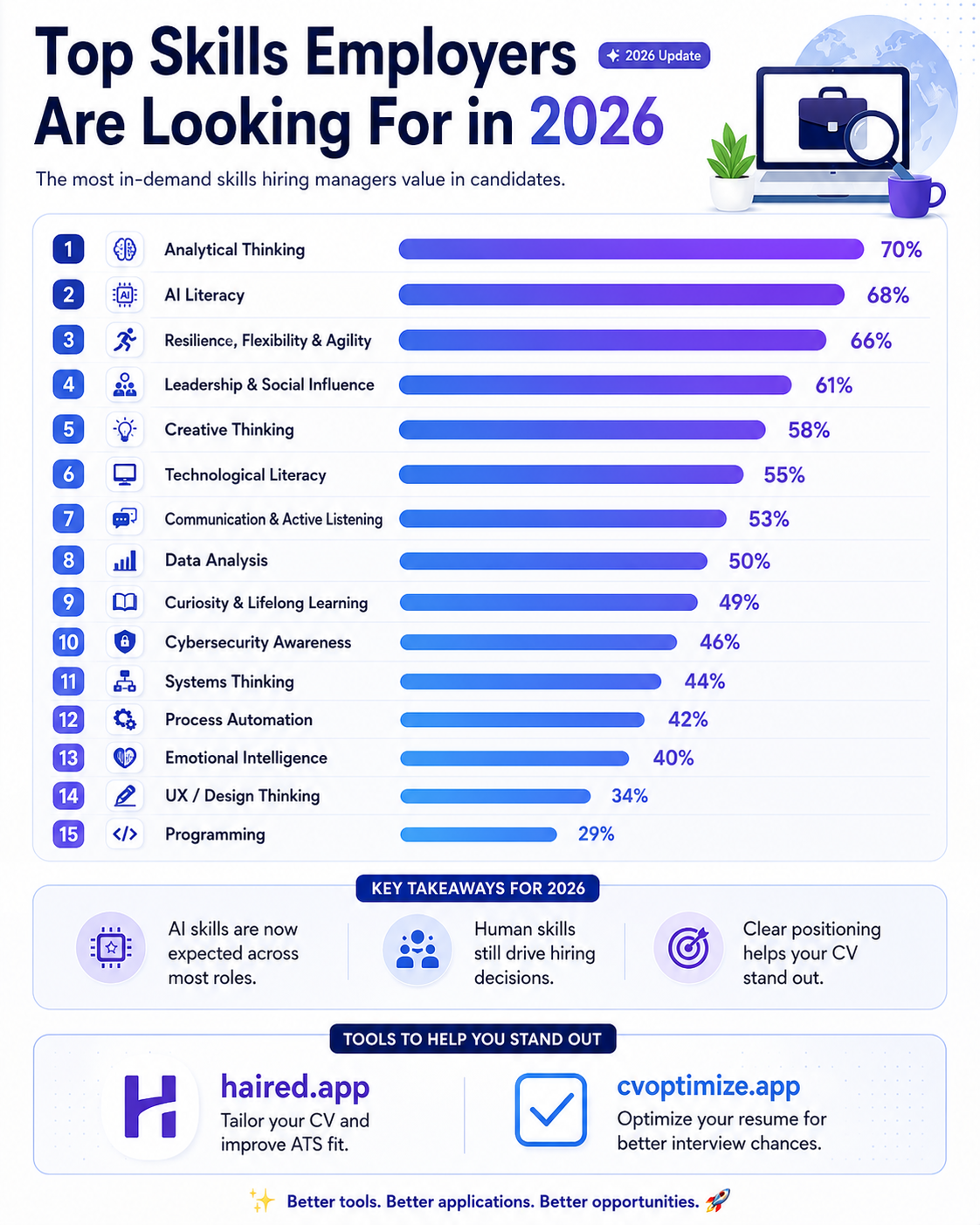
The Headline Number: 39% of Skills Will Change by 2030
The WEF Future of Jobs Report 2025 puts a hard figure on something most people feel intuitively: employers expect 39% of the core skills required in today's job market to change by 2030. That's actually down from 44% in the 2023 edition — not because change slowed, but because the pandemic-era disruption baseline was unusually extreme.
LinkedIn's Skills on the Rise 2025 frames the same shift over a longer window and arrives at a more dramatic number: 70% of the skills used in most jobs will change between 2015 and 2030, with AI cited as the primary catalyst. And 91% of the learning-and-development professionals LinkedIn surveyed agree that continuous learning is "more important than ever" for career success.
Whichever number you use, the takeaway is the same: the skills that got you your last job are not a safe bet for your next one.
The #1 Skill in Every Single Report: AI Literacy
This is the one place all four reports line up almost perfectly.
- The WEF Skills Outlook ranks AI and big data as the technological skill projected to grow faster than any other over the next five years — ahead of networks and cybersecurity, and general technological literacy.
- LinkedIn's global ranking puts AI literacy at the very top of the most common rising skills across regions, alongside large language model (LLM) proficiency.
- Coursera's Job Skills Report 2026 recorded a 234% year-over-year increase in Generative AI enrollments among enterprise learners — the single fastest-growing category it tracks.
- Coursera's Global Skills Report confirms it at scale: Generative AI is the fastest-growing skill category worldwide, with over 8 million enrollments globally.
If you take one thing from this article, it's this: "AI literacy" doesn't mean listing "ChatGPT" as a skill. It means being able to use AI tools to actually do your job faster or better — prompt engineering, evaluating AI output critically, and knowing where AI is unreliable. That distinction is exactly what recruiters are starting to screen for.
The Full Top 10 (According to WEF)
The WEF Skills Outlook is the most comprehensive of the four reports, and its top 10 rising skills for 2025-2030 blends technology with distinctly human capabilities:
| Rank | Skill | Category |
|---|---|---|
| 1 | AI and big data | Technology |
| 2 | Networks and cybersecurity | Technology |
| 3 | Technological literacy | Technology |
| 4 | Creative thinking | Cognitive |
| 5 | Resilience, flexibility and agility | Human |
| 6 | Curiosity and lifelong learning | Human |
| 7 | Leadership and social influence | Human |
| 8 | Talent management | Human |
| 9 | Analytical thinking | Cognitive |
| 10 | Environmental stewardship | Human |
Notice that 6 of the top 10 are distinctly human skills, not technical ones. The report's framing is consistent: technology creates the demand, but human judgment decides who keeps their job.
Where Rankings Differ by Country and Region
This is the part most "top skills" listicles skip, and it's the most actionable part of LinkedIn's report: the exact skill mix depends heavily on where you're job hunting.
| Region | Standout skills in the top rankings |
|---|---|
| United States | AI literacy, conflict mitigation, adaptability, process optimization, innovative thinking |
| UK, Australia, Brazil, Germany | AI literacy consistently in the top rankings |
| France, Spain | Customer service skills alongside AI competencies |
| India | Innovative thinking and code review (uniquely emphasized) |
The pattern: AI literacy is close to universal, but the second most valuable skill on your resume should be tailored to your specific market — not copy-pasted from a US-focused listicle.
Coursera's Global Skills Report adds a regional data point that surprises a lot of people: Latin America leads the world in Generative AI enrollment growth, up 425% year-over-year — the highest of any region tracked, ahead of North America and Europe. Singapore, meanwhile, ranks #1 in Asia-Pacific for both skill proficiency and Coursera's new AI Maturity Index.
Skills by Industry: What's Actually Growing Where
Generic "top skills" lists are close to useless if you work in a specific function. LinkedIn's data, broken down by role, is far more useful:
- Engineering / IT: Large language models and technical documentation
- Sales: Lead qualification and growth strategies
- Marketing: Budget management and social media management
- Healthcare: Health information management and compliance
Coursera's Job Skills Report 2026, which draws on data from 6 million enterprise learners across nearly 7,000 organizations, zooms in specifically on data roles and finds the same underlying shift: the fastest-growing data skills aren't classic database or spreadsheet skills anymore.
| Rank | Fastest-growing data skill (Coursera 2026) |
|---|---|
| 1 | Multimodal prompts |
| 2 | Critical thinking |
| 3 | AI personalization |
| 4 | Prompt engineering |
| 5 | Excel formulas |
As the report puts it directly: "Data professionals are shifting focus from hands-on database work to managing AI layers that now drive analysis, increasingly relying on human judgment to validate results." Notice that critical thinking — a distinctly human skill — sits at #2, right next to two AI-specific skills. This mirrors the WEF finding above: technical fluency gets you in the door, judgment keeps you employed.
Coursera also logged a 120% average year-over-year increase in critical thinking enrollments and a 91% increase in Professional Certificate enrollments across its enterprise learner base — a sign that companies are actively pushing employees to formalize these skills, not just pick them up informally.
What's Actually Declining
Almost nobody covers this part, but it matters just as much as what's rising. According to the WEF Future of Jobs Report 2025:
- Manual dexterity, endurance, and precision shows the steepest anticipated decline — 24% of employers expect it to matter less by 2030.
- Reading, writing, and mathematics as standalone, generic skills show a smaller net decline — not because literacy stops mattering, but because baseline competency is increasingly assumed, and employers are screening for what you do with those skills (analysis, communication, synthesis) rather than the skills themselves.
This doesn't mean "don't list writing on your resume." It means don't list it as if it were differentiating — pair it with an outcome (e.g., "wrote technical documentation that reduced onboarding time by 30%") instead of listing it as a bare skill.
The Bigger Picture: Jobs Created vs. Jobs Displaced
It's worth zooming out before you panic about any of the above. The WEF report also models total job creation and displacement through 2030:
- 170 million new roles are expected to be created
- 92 million existing roles are expected to be displaced
- Net effect: +78 million jobs
- Total job disruption (creation + displacement combined) equals 22% of today's total jobs
In other words: this isn't a story about AI eliminating work. It's a story about work changing shape faster than most people's resumes are updating. The people who get displaced aren't necessarily in "AI-replaceable" jobs — they're the ones who didn't update their skill set fast enough to move into one of the 170 million new roles.
What This Means for Your Resume in 2026
Pulling this together into something you can actually act on:
- Add AI literacy — specifically. Not "familiar with ChatGPT." Name the tools, the use case, and a measurable outcome (time saved, output quality, volume handled).
- Pair every technical skill with a human one. WEF's own data shows 6 of the top 10 rising skills are human, not technical — analytical thinking, adaptability, and creative thinking read as differentiators precisely because most applicants only list the technical half.
- Localize your second-tier skills. If you're applying in France or Spain, customer service credentials carry more weight than in the US. If you're in India, code review experience stands out more than it would elsewhere.
- Stop listing bare "reading/writing/communication." Convert it into an outcome. Recruiters and applicant tracking systems both reward specificity over generic soft-skill claims.
- If you're in a data or IT role, mention prompt engineering and AI-output validation explicitly — these are now tracked as distinct, fast-growing competencies, not lumped under "AI" generally.
This is exactly the kind of resume gap Haired's CV Optimizer is built to catch — it checks whether your resume reflects current in-demand skills for your specific role and region, not a generic template from three years ago.
Skills to Have on Your Resume in 2026 (Copy-Paste Ready List)
If you're short on resume ideas for skills, here's a categorized list of skills to write in your resume in 2026 — pulled directly from the WEF, LinkedIn, and Coursera data above, not a generic "soft skills" template you've seen a hundred times.
AI & technical skills to have on your resume:
- AI literacy / applied AI tools (name the specific tool and use case)
- Prompt engineering
- Large language model (LLM) proficiency
- Multimodal prompts
- AI output validation / AI personalization
- Networks and cybersecurity fundamentals
- Data analysis with AI-assisted tools
Human and cognitive skills to have on your resume:
- Analytical thinking
- Creative thinking
- Adaptability and flexibility
- Curiosity and continuous learning
- Leadership and social influence
- Talent management (if you manage people or projects)
Role-specific resume ideas for skills:
- Engineering / IT: LLM integration, technical documentation
- Sales: lead qualification, growth strategy
- Marketing: budget management, social media management
- Healthcare: health information management, compliance
- Data roles: multimodal prompts, critical thinking, prompt engineering, Excel formulas
Don't just copy this list verbatim onto your resume, though — the skills that actually move the needle are the ones backed by a specific, measurable example. "Prompt engineering" as a bare bullet point is easy to skim past; "Used prompt engineering to cut report-writing time by 40%" is not.
Is Your Resume Missing the Skills Employers Want in 2026?
Get a free, instant analysis of your CV against the skills employers are actually hiring for right now — no credit card required.
- Premium ATS-optimized templates
- AI-powered keyword optimization
- Instant ATS score checker
Sources & Methodology
This article synthesizes publicly available data from four reports, without altering or extrapolating beyond what each source states:
- World Economic Forum — Future of Jobs Report 2025
- World Economic Forum — Skills Outlook (Future of Jobs Report 2025, Chapter 3)
- LinkedIn — Skills on the Rise 2025
- Coursera — Job Skills Report 2026
- Coursera — Global Skills Report
Figures are attributed to their original source throughout; where reports disagree (e.g., 39% vs. 70% skill change), both figures are presented rather than averaged or reconciled, since they measure different time windows and methodologies.
About Haired
Haired is an AI-powered career platform based in Barcelona, Spain. Our tools — including the CV Optimizer, Resume Builder, and LinkedIn Analyzer — help candidates align their resumes with the skills employers are actually screening for today, not the ones that mattered five years ago.
